
A HOLISTIC PERSPECTIVE
No one part is greater than the whole.

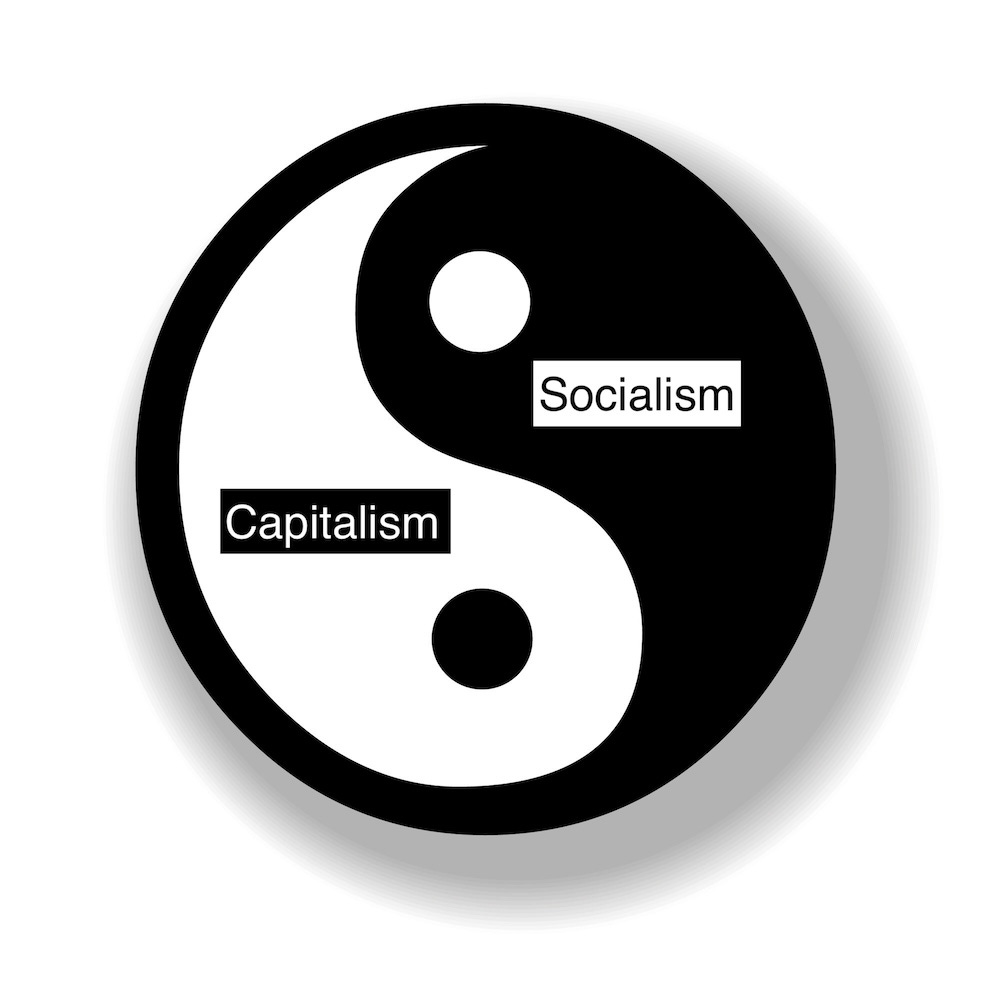
A holistic perspective is a realistic perspective based on the fact that no part of any system is greater than the whole. Social systems are no exception.
For any group, individual or faction to regard themselves as greater than the whole society is, as we see, a recipe for division, disruption, distress.
The claims to absolute supremacy by one faction or another is a consequence of, among other things, the belief that a particular ideology is sacrosanct, beyond criticism and must be installed as the one supreme authority to the elimination of all others.
At root, that belief is fostered by the erroneous notion that ideologies such as capitalism and socialism are diametrically opposed.
That notion, held by pretty much the whole world, is a fallacy.
What we need to do is see the world as it is. Not how we imagine it in our heads.
Look at the Western Democracies. Of the most successful nations ever. They are all a combination of capitalism and socialism to one degree or another. And that is what works!
But, let’s apply some science here and reduce these isms to their fundamental elements. When we do that we simply get the private sector and the public sector. A duality that any viable social system needs to sustain itself. And they need each other.
Here is the maxim - The public sector needs the private sector to fund its programs and the private sector needs the public sector to provide a viable social system wherein business can thrive.
So, the two sectors are reciprocal not adversarial. And the correct approach to capitalism and socialism is to impartially manage their reciprocal relationship so as to benefit the whole society.
We need to cultivate an appreciation of the big picture wherein everything has its place in maintaining and contributing to a synergistic whole.
A holistic perspective exposes the fact that the pernicious political/ideological divide that now presides over everything has, as we shall see, no basis in reality. This divide has become “normalized” through an erroneous agreement by the left and the right that their ideologies are hopelessly at odds with one another.
A holistic perspective offers a worldview where ideological conflict becomes a relic of the past.
Our enlightened view of capitalism and socialism seamlessly incorporates them within the social fabric.
So, capitalism and socialism has been revealed as private sector and public sector. Continuing the process the private sector and public sector is reduced to self-interet and collective-interest. And like capitalism and socialism self-interest and collective-interest are popularly seen as being diametrically opposed to one another.
However, they are not. They form a dynamic. A dynamic that is fundamental to every social system that ever was and ever will be.
We unknowingly participate in that dynamic every day we go to work.
We need to work to make money. Money is how we survive. How we go on living. It provides us with food, clothing, shelter and whatever else we deem necessary for a fulfilling life. So, we get a job. That means we become part of a business, a collective. And we contribute to that collective’s survivability by helping to maintain its profitability. In doing so we receive a paycheck to provide for our self-interest.
So, the collective-interest of the business is served by the self-interest of its employees. In fact, both the self-interest of the employer and the employees create and support the collective-interest of the business. And through that collective participation they all earn money. Collective-interest serves self-interest and vice versa. It’s a dynamic. One that is hiding in plain sight as we participate in it every work day.
Self-interest is not an ideology. Neither is collective-interest. But capitalists and socialists view those interests as separate elements to champion according to their preferred dogma. It is a view that is artificially imposed on a social system and one that is contradicted in workplaces on a daily basis all over the world.